
VDN100 Series Sensorless Vector VFD | High-Performance AC Drive 0.4-630kW
The VDN100 Series is a versatile, high-performance general-purpose inverter designed for precise control of three-phase AC asynchronous motors. It offers exceptional reliability and adaptability for a wide range of industrial applications. Featuring both V/F and advanced open-loop vector control modes, the VDN100 delivers strong starting torque, comprehensive protection functions, and flexible configuration options. Its robust design, conformal-coated circuit boards, and support for multiple communication protocols ensure stable operation even in harsh environments.
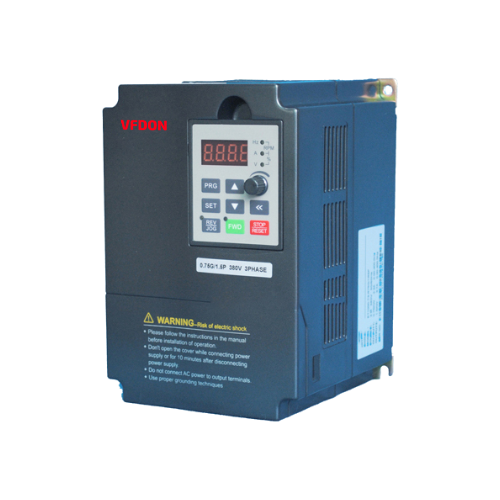
Technical Parameter
660V/1140V Class: Up to 630kW
Three-phase 220V/380V/660V/1140V: -15% ~ +15%, 50/60Hz ±5%
Key technical advantage
- High Starting Torque: Provides robust starting torque, with an automatic torque boost function adjustable from 0.0% to 25.0%, ensuring reliable starting even for high-inertia loads.
- Flexible Frequency Control: Supports a wide range of frequency sources, including digital keypad, potentiometer, analog signals (0-10V, -10V-+10V, 4-20mA), pulse input, and RS485 communication. Multi-channel combinations are also available.
- Powerful Process Control: Features built-in PLC functionality with programmable multi-step speeds (up to 15 speeds), PID control (for process control like constant pressure), and swing frequency control for applications like textile machinery.
- Advanced Protection Features: Comprehensive protection includes over-current, over-voltage, under-voltage, over-load, over-heat, input/output phase loss, and short-circuit protection. Includes features like automatic fault reset and speed tracking restart.
- Robust Communication: Standard built-in RS485 interface with Modbus-RTU protocol, enabling easy integration into industrial automation networks. Profibus-DP optional.
- Enhanced Reliability: Conformal-coated PCBs protect against dust and humidity. The cooling fan operation mode is selectable to extend fan life.
Avaliable Product List
| Model | Rated Current (A) | Compatible Motor Power (kW) | Magnetic Contactor Rating (A) | Circuit Breaker Rating (A) | Main Circuit Wire Gauge |
| VDN100-R75G3/1R5P3 | 2.3 | 0.75 | 10 | 10 | 2 mm² |
| VDN100-1R5G3/2R2P3 | 3.7 | 1.5 | 10 | 10 | 2 mm² |
| VDN1002R2G3/3R7P3 | 5 | 2.2 | 10 | 10 | 2 mm² |
| VDN100-3R7G3/5R5P3 | 8.5 | 3.7 | 20 | 20 | 4mm² |
| VDN100-5R5G3/7R5P3 | 13 | 5.5 | 20 | 30 | 4mm² |
| VDN100-7R5G3/011P3 | 17 | 7.5 | 30 | 30 | 6mm² |
| VDN100-011G3/015P3 | 25 | 11 | 30 | 50 | 8mm² |
| VDN100-015G3/018P3 | 32 | 15 | 35 | 60 | 10mm² |
| VDN100-018G3/022P3 | 38 | 18 | 50 | 75 | 16mm² |
| VDN100-022G3/030P3 | 45 | 22 | 50 | 100 | 16 mm² |
| VDN100-030G3/037P3 | 60 | 30 | 80 | 125 | 25mm² |
| VDN100-037G3/045P3 | 75 | 37 | 80 | 150 | 25 mm² |
| VDN100-045G3/055P3 | 90 | 45 | 100 | 200 | 35 mm² |
| VDN100-055G3/075P3 | 110 | 55 | 180 | 225 | 35 mm² |
| VDN100-075G3/093P3 | 150 | 75 | 180 | 300 | 50 mm² |
| VDN100-093G3/110P3 | 180 | 93 | 250 | 350 | 50mm² |
| VDN100-110G3/132P3 | 210 | 110 | 250 | 400 | 60 mm² |
| VDN100-132G3/160P3 | 250 | 132 | 400 | 500 | 80 mm² |
| VDN100-160G3/185P3 | 310 | 160 | 400 | 600 | 80 mm² |
| VDN100-185G3/200P3 | 340 | 185 | 500 | 600 | 100 mm² |
| VDN100-200G3/220P3 | 380 | 200 | 600 | 600 | 100 mm² |
| VDN100-220G3/250P3 | 415 | 220 | 600 | 800 | 150 mm² |
| VDN100-250G3/280P3 | 470 | 250 | 600 | 800 | 150mm² |
| VDN100-280G3/315P3 | 510 | 280 | 600 | 1000 | 150mm² |
| VDN100-315G3/355P3 | 600 | 315 | 800 | 1000 | 200mm² |
| The above reference data is based on the G-type model. For P-type models, please select the appropriate accessory specifications based on the working conditions and the G-type model of the same power listed in the table above. |
Related Application
FAQ
What is the difference between the VDN100 G-type and P-type models?
The VDN100 series uses a G/P (General/Pump) integrated design. G-type (Constant Torque) is for heavy-duty applications like conveyors and extruders, with an overload capacity of 150% for 60 seconds. P-type (Variable Torque) is for fans and pumps, with an overload capacity of 120% for 60 seconds. The P-type model can drive a motor one power class higher than the equivalent G-type frame.
How do I set the VDN100 for multi-step speed control?
First, assign the multi-step speed functions (5-8 for Speed 1-4) to digital input terminals X1-X6 via parameters P1.01 to P1.06. Then, set the desired frequencies for each of the 15 speeds in parameters P1.09 to P1.23. The combination of ON/OFF states of the four speed control terminals determines the active speed step.
What should I do if the motor runs unsteadily or with vibration at low speeds?
Try increasing the carrier frequency (P0.20) appropriately to improve the current waveform. You can also enable the “Random PWM” mode (P0.21, LED hundreds place) to spread the harmonic spectrum and reduce vibration. Ensure the torque boost (P0.18) is not set too high.
Can the VDN100 perform closed-loop control for constant pressure water supply?
Yes. Select PID control as the frequency source (e.g., P0.02 = 8 or 9 for Normal PID or Constant Pressure PID). Set the PID given source (P2.12) and feedback source (P2.13, e.g., using the AS terminal for a 4-20mA pressure sensor). Adjust PID parameters (P2.19-P2.21) for optimal system response.
How can I reset the VDN100 inverter to factory default settings?
Set parameter P0.64 to 1. This will restore all parameters to their factory defaults. Note that parameters P0.46 (Running Direction Selection) and P0.61 (G/P Type Setting) are not affected by this reset.
What does an "o.C.1" (Accelerating Over-current) fault indicate and how do I fix it?
This fault typically occurs if the acceleration time (P0.13) is too short, the V/F curve or torque boost (P0.17, P0.18) is set too high, or if the motor is started while still spinning. Try extending the acceleration time, adjusting the V/F characteristics, or enabling speed tracking restart (P0.30 = 2).